+90-548-875-8000
+90-548-876-8000
Elite Hospital
North Cyprus
Follow Us on
Social Media

A couple can be considered infertile if one or more of the following conditions are present:
The couple where the female partner is under the age of 35 has been trying to conceive naturally without use of any contraception for over one year without any success.
The couple where the female partner is over the age of 35, but not yet in menopause, has been trying to conceive naturally without the use of any contraception for over 6 months without any success. The older the female patient, the more likely she is to be a candidate for infertility, therefore, in more advanced age brackets, the diagnosis is made in a shorter period of time compared to patients in younger age brackets.
The female patient is able to get pregnant but is incapable of carrying pregnancy to a full term.
There are a number of problems that can contribute to infertility in women. Main factors that cause female infertility can be listed as the following:
Problems with ovulation account for most cases of infertility in women. Without ovulation, there are no eggs to be fertilized. Some signs that a woman is not ovulating normally include irregular or absent menstrual periods. In order to make an assessment, the patient is asked to undergo hormone testing and a pelvic scan. More advanced testing might be necessary for certain patient groups. Patients entering menopause or patients with premature ovarian failure belong in this category. Patients who have received chemotherapy or radiation therapy are also likely to face problems with their ovarian reserves.
Blocked fallopian tubes due to pelvic inflammatory disease, endometriosis, or surgery for an ectopic pregnancy can also cause infertility. In these cases, there is ovulation, and the patient may have a sufficient reserve of oocytes, but one of the main component of the reproductive system does not allow the eggs to be released for fertilization to occur.
Physical problems with the uterus. Shape or size of the uterus can be a problem, or there might be polyps, fibroids or free fluids in the uterus that might interfere with implantation or maintaining a successful pregnancy.
More and more women are waiting until their 30s and 40s to have children. Actually, about 20 percent of women in the United States now have their first child after age 35. So age is an increasingly common cause of fertility problems. About one third of couples in which the woman is over 35 have fertility problems. Aging decreases a woman’s chances of having a baby in the following ways:
The quality and quantity of the eggs remaining in the ovarian reserves decline with age. Each woman is born with a finite number of eggs and starting at puberty, the number of eggs declines through menstruation. One indication of this is high FSH and a low AMH level. (Please see Infertility)
The genetic health of a woman’s eggs declines with age. Just like any other cell in our bodies, the egg cells also age. Given that ovaries do not produce any new egg cells over the course of female life, the ones that you are born with tend to age over time. This also increases the likelihood of miscarriages in advanced age brackets.
As a woman ages she is more likely to have health problems that can interfere with fertility. This can include diabetes, coronory and vascular problems and many others.
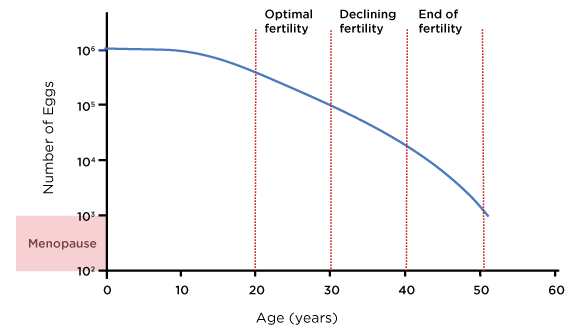
Graphic to the right depicts the amount of ovarian reserves at different age brackets. Every woman is born with a limited number of ovarian reserves and this number declines with age.
While a newborn will have approximately about one million follicles in her ovaries, this number declines to about 100,000 by the time she reaches 30 years of age. This means, she will have lost 90% of her ovarian reserves by the age of 30 and this decline becomes even sharper in later years.
While in menopause there seems to be some reserves remaining, these are no longer viable for pregnancy.
Many things can negatively affect a woman’s ability to have a baby. These include:
Most healthy women under the age of 30 shouldn’t worry about infertility unless they’ve been trying to get pregnant for at least a year. At this point, women should talk to their doctors about a fertility evaluation. Men should also seek attention if they have been trying to conceive but have been unable to do so. In some cases, the couple should not wait a year before seeking attention. For instance, if the female patient has irregular menstrual periods or has experienced recurrent miscarriages, further investigation will be needed.
Some health issues also increase the risk of fertility problems. So women with the following issues should speak to their doctors as soon as possible:
No matter how old you are, it’s always a good idea to talk to a doctor before you start trying to get pregnant. Doctors can help you prepare your body for a healthy baby. They can also answer questions on fertility and give tips on conceiving. At North Cyprus IVF, we make sure that each and every patient is assessed individually based on their own unique history of infertility. This helps us achieve higher success rates with our patients. Please see the Infertility section for more information on infertility testing.
Please contact us for more detail on Female Infertility.
Medically Reviewed by
Assoc. Prof. Dr. Savas Ozyigit